Overview
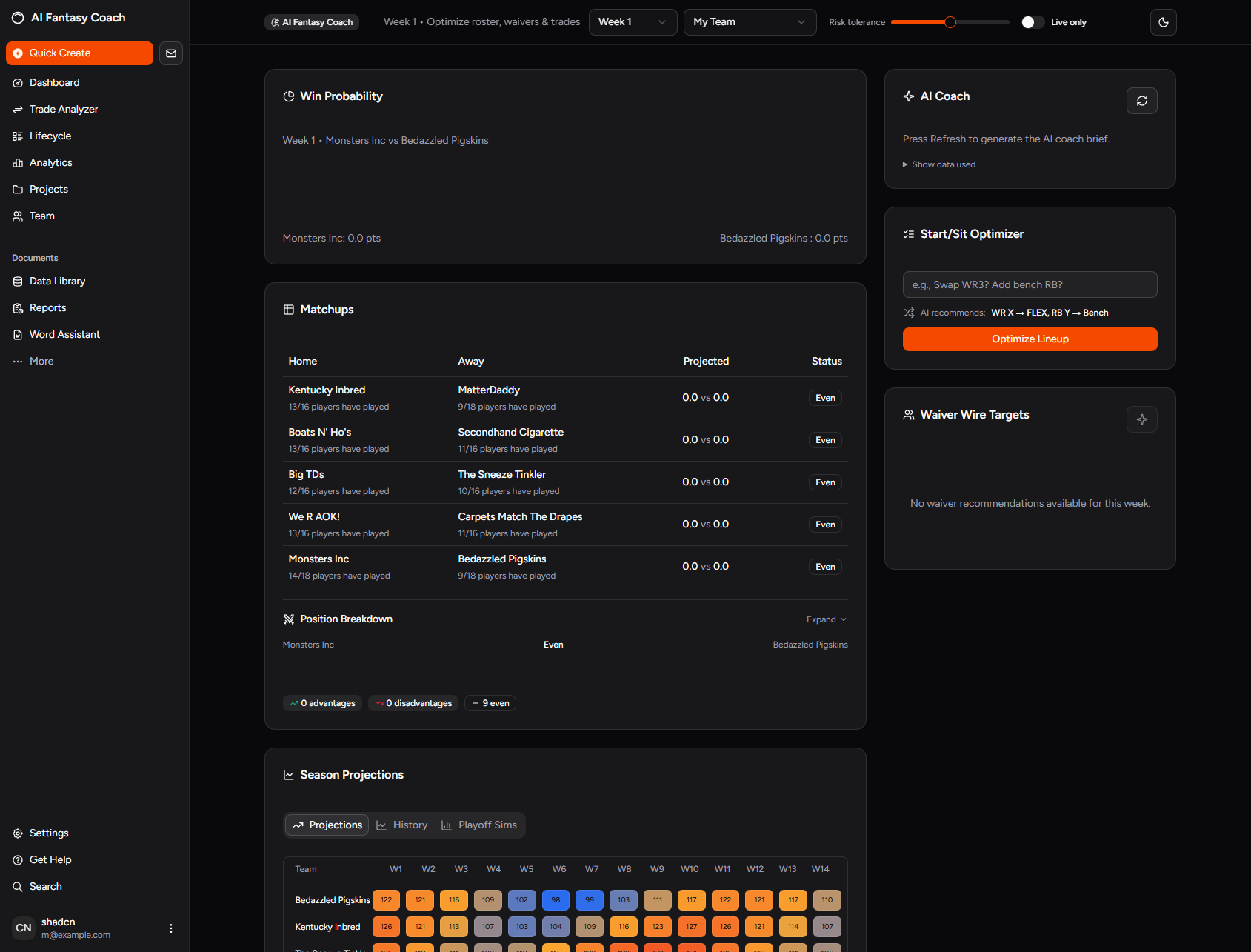
AI Fantasy Coach is a full-stack dashboard that connects to the ESPN Fantasy API, pulls live league data, and runs it through OpenAI to generate actionable weekly coaching intelligence. The result: start/sit decisions, waiver wire picks, win probability charts, and playoff simulations — all personalized to your actual roster and matchup.
This started as a personal tool to stop making gut-feel lineup decisions and turned into a production app on Vercel.
Live: ai-fantasy-coach.vercel.app
GitHub: github.com/jakekaminski/ai-fantasy-coach
Stack
- Framework: Next.js 15 (Turbopack), React 19
- UI: shadcn/ui, Radix primitives, Tailwind CSS v4
- AI: OpenAI SDK (GPT-4o) — streaming responses
- Data viz: Recharts — win probability curves, projection charts
- Tables: TanStack Table — sortable roster/waiver views
- DnD: dnd-kit — drag-and-drop lineup builder
- Validation: Zod — typed ESPN API response schemas
- Deployment: Vercel
Features
ESPN Fantasy API integration
Connects to ESPN's unofficial fantasy API to pull live league data: rosters, matchups, transactions, standings, and player projections. All ESPN API responses are validated with Zod schemas to catch shape changes early.
AI Coach Briefing
Every week, OpenAI generates a coaching briefing for your matchup — summarizing your roster strengths, your opponent's threats, and a recommended game plan. A risk tolerance slider adjusts the briefing from conservative (protect your lead, start proven players) to aggressive (take the ceiling swing).
Briefings are streamed via the OpenAI streaming API so you get content progressively rather than waiting for the full response.
The briefing prompt includes full roster data, injury reports, recent performance trends, and historical head-to-head data — giving the model context that most tools ignore.
Start/Sit Optimizer
Presents your flex decisions as a comparison view — AI score projection, recent form, injury status, and a recommendation with reasoning. Built on TanStack Table with sortable columns so you can slice the data however you want.
Win Probability & Season Projections
Recharts-powered visualizations:
- Win probability curve — updates as the week's real scores come in
- Season projection chart — playoff probability trending across the season
- Points-for vs. points-against scatter plot across the league
Waiver Wire Intelligence
Given your roster holes (identified by OpenAI from your lineup submission history), the waiver analysis surfaces pickups ranked by impact — not just by raw points projection.
Playoff Simulator
Monte Carlo-style bracket simulation running 10,000 season iterations to generate playoff probability percentages for every team in the league. Rendered as a visual bracket with probability overlays.
Mobile-first responsive design
Bottom nav on mobile for thumb-reachable access to the key weekly views: Lineup, Briefing, Waiver Wire, and Standings. Desktop expands to a full sidebar layout.
Architecture notes
Why Next.js App Router?
Server components made sense for the data-heavy views — roster tables and
standings render server-side, reducing client bundle size and avoiding
waterfall fetches.
Why not a dedicated fantasy data provider?
ESPN's API is free and covers all the data points needed. The tradeoff is
instability (it's unofficial), which is why every response shape is validated
with Zod. When ESPN changes something, the app fails fast with a clear error
rather than silently displaying wrong data.
Streaming AI responses
The coaching briefing uses OpenAI's streaming API via Next.js route handlers.
The frontend uses ReadableStream to progressively render the briefing as it
arrives — same pattern as ChatGPT's typewriter effect.
The full weekly briefing (roster analysis + matchup breakdown + game plan) typically completes in under 8 seconds on GPT-4o — fast enough that streaming feels natural rather than necessary.